

The Biggest Barrier to Apprenticeship Adoption isn’t Talent. It’s Friction.
by Michelle Sims, CEO, YUPRO Placement
What Employers Need to Make Apprenticeship Programs Work at Scale.
Employers across industries are rethinking how they build talent pipelines. Pressures to
reduce costs compete equally with pressures to complete important initiatives on time. At the same time, an aging workforce, high hiring costs, and vital skills gaps remain challenges.
Apprenticeships offer a compelling path forward combining work-based learning, workforce development, and long-term talent cultivation into a single model. These programs provide access to talent with specialty skills and demonstrated ability to learn on the job.
Yet apprentices represent less than 0.3% of the U.S. workforce. In 2025, the U.S. Government Accountability Office asked employers directly what was holding them back from expanding apprenticeship programs. Their answer: administrative burden.
The concept has never been the problem. The infrastructure around it has.
Many apprenticeship programs still struggle to gain meaningful employer adoption, not
because employers reject the model, but because the operational complexity is difficult to navigate, difficult to sustain, and often disconnected from immediate business realities.
Where Employer Adoption Breaks Down
To adopt apprenticeship programs, employers need to see a clear pathway, free of
barriers, that addresses long and short term needs. Most friction is operational, not
conceptual and fixable. Employers aren’t resistant to apprenticeships. They’re
resistant to programs that don’t fit how their organizations actually run.
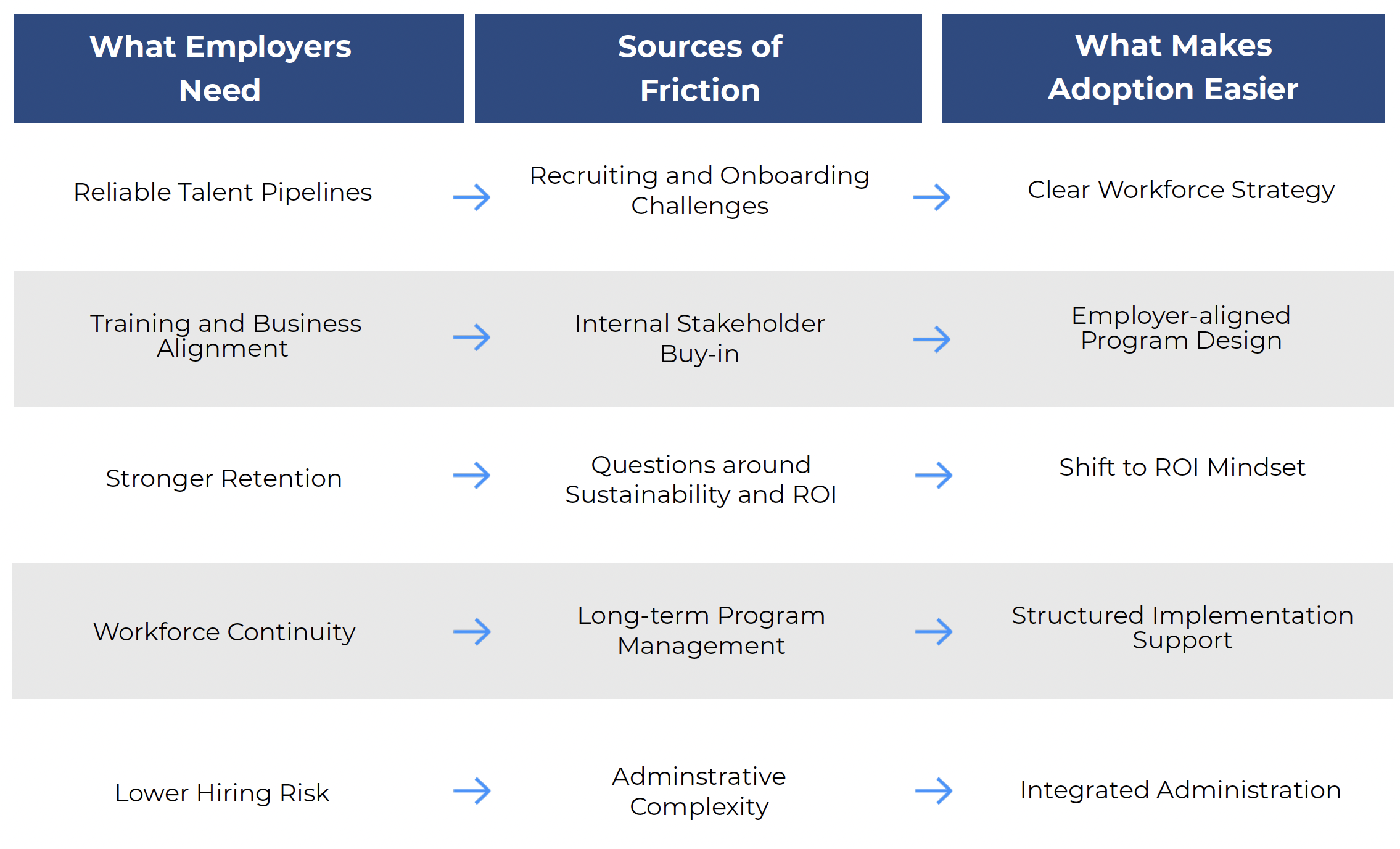
Employers don’t always immediately see how apprenticeship programs fit into the realities of running a business. Hiring managers and operational leaders are already balancing productivity pressures, workforce shortages, budget constraints, and changing skill requirements. Even organizations interested in apprenticeships may hesitate if the process feels difficult to operationalize.
For workforce organizations, training providers, and apprenticeship advocates, this creates an important shift in focus.
The conversation is no longer about promoting apprenticeships;
it is about reducing the friction that prevents employer adoption in the first place.
Apprenticeships Need More Than Advocacy
Many apprenticeship conversations still focus primarily on awareness, funding, or program promotion. While those efforts matter, employer adoption often depends on something more practical.
For employers, apprenticeship programs introduce new layers of coordination:
- workforce planning
- recruiting and onboarding
- training alignment
- payroll and compliance
- retention support
When these responsibilities are fragmented across multiple partners, apprenticeship programs can become difficult to manage and difficult to sustain. The organizations seeing the strongest long-term outcomes are often the ones focused not just on launching
apprenticeship programs, but on operationalizing them.
That means creating systems that make apprenticeship programs easier for employers to adopt, easier for managers to support, and easier for workforce organizations to sustain over time.
What Drives Employment Adoption
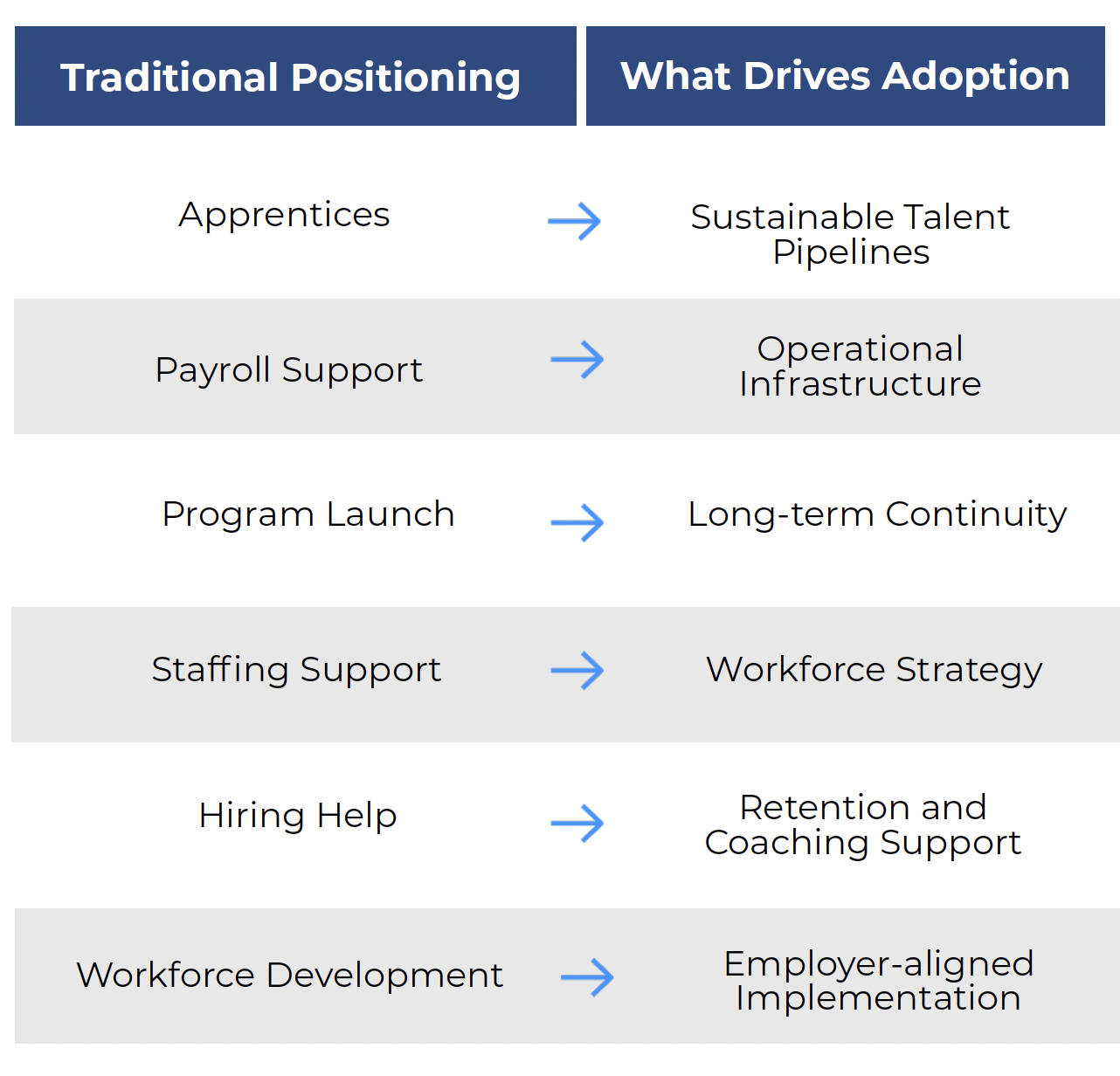
Organizations supporting apprenticeship programs are recognizing that employer adoption depends on reducing complexity, clarifying implementation, and creating a model that aligns with real business operations.
The more apprenticeship programs feel practical, scalable, and sustainable, the more likely employers are to move from interest to adoption.
Building for Scale, Not Just Launch
Successful apprenticeship programs are rarely built through a single organization working alone.
They require coordination across employers, workforce organizations, training providers, funding entities, and operational partners, all aligned around the same goal: creating a pipeline of talent that can most efficiently address large scale challenges.
That coordination becomes significantly easier when apprenticeship programs are designed around the employer experience itself.
Programs that reduce friction for employers are more likely to:
- gain internal buy-in
- secure long-term participation
- improve retention outcomes
- create stronger workforce continuity
- scale beyond pilot stages
- become embedded into workforce strategy
As apprenticeship adoption continues to evolve, the organizations leading the next phase of growth will not simply be the loudest advocates for apprenticeships; they will be the organizations most capable of making apprenticeship programs work in practice.
Stay Up-to-Date with the Latest on Skills-First Hiring Resources
Sign up for YUPRO Placement Emails
"*" indicates required fields